
Louisville Fence Permits, Rules and Property Lines
Fence permit guide · checked October 2026
Louisville fence permits, rules and property lines
Most residential fences in Louisville Metro don’t need a building permit. Metro only requires one for fences over 7 feet tall. Height limits still apply: 4 feet in most front yards, and up to 6 feet (see-through) or 8 feet (solid) in side and back yards. Many small cities in Jefferson County, and many HOAs, set their own rules.
Owner and Operator, Miles Fence Company · Rules checked October 2026
When Louisville Metro requires a fence building permit
Most front yards in Metro’s suburban areas (42 in. in traditional neighborhoods)
Minimum notice to Kentucky 811 before anyone digs
Louisville Metro
Do you need a permit for a fence in Louisville?
In Louisville Metro, a building permit is only required for fences over 7 feet tall. That covers most of Jefferson County, including unincorporated areas like Fern Creek, Fisherville, Okolona and Highview. But not needing a permit doesn’t mean anything goes. Metro’s Land Development Code still limits how tall a fence can be, and where.
| Where on the lot | Maximum height | Notes |
|---|---|---|
| Front yard and street-side yard (suburban neighborhoods) | 4 ft | Applies inside the front and street-side setback |
| Front yard and street-side yard (traditional neighborhoods) | 42 in. | Older, denser areas zoned as traditional form districts |
| Side and back yard, see-through fence | 6 ft | Less than 80% opaque, such as chain link or aluminum |
| Side and back yard, solid fence | 8 ft | 80% opaque or more, such as wood or vinyl privacy. Over 7 ft needs a permit |
Source: Louisville Metro Codes & Regulations and Construction Review. Within 5 feet of a public sidewalk or road, any change in ground height counts toward the fence height. Not sure which form district you’re in? Metro Planning & Design can tell you: (502) 574-6230.
Not sure what your yard allows?We make sure every fence we install complies with local rules, and estimates are free. Call 502-354-9162.
Small cities
Cities in Jefferson County that set their own rules
Twelve cities inside Jefferson County have their own zoning authority: Anchorage, Douglass Hills, Graymoor-Devondale, Hurstbourne, Indian Hills, Jeffersontown, Lyndon, Middletown, Prospect, Shively, St. Matthews and St. Regis Park. If you live in one of them, check with the city before you build. Some require their own approval or permit even when Metro doesn’t.
| City | City permit or approval? | What we know |
|---|---|---|
| Jeffersontown | No permit required | Front and street-side yards up to 4 ft. Side and rear: solid fences up to 8 ft, chain link up to 6 ft. On corner lots, fences can’t block drivers’ view of the intersection. Planning & Development Review, (502) 267-8333 |
| Prospect | Yes, a city building permit | The city’s permit application lists a 6 ft maximum, fences limited to the back yard on subdivision lots under 3 acres, no chain link, and the finished side of a wood fence facing the neighbors. Ask the city to confirm these are current: (502) 228-1121 |
| Hurstbourne | Yes, a city building permit | The permit form asks for fence product details and a surveyed plot plan showing the fence location. (502) 426-4808 |
| Douglass Hills | Yes, a city letter of compliance | Reviewed by the City Engineer; a fee may apply. Contact City Hall, 219 Moser Rd |
| St. Matthews | Check with the city | The city issues a free letter of compliance before any Metro building permit. Ask Planning whether your fence needs one: (502) 899-2512 |
| Shively | Check with the city | The city issues compliance certificates before Metro permits. (502) 449-5000 |
| Middletown, Lyndon, Anchorage and the other cities | Check with the city | Call city hall before you build and ask about fence height limits and whether you need a letter of compliance |
From each city’s own website or permit forms, checked October 2026. City rules change, so confirm with the city before you build. Live in Southern Indiana? Indiana cities and counties have their own rules too.
HOAs
HOA approval comes first
Some HOAs require architectural committee approval before work can begin, and many limit fence height, material, color or style, sometimes more strictly than the city does. A fence that meets Metro’s rules can still break your HOA’s, so check with your HOA first.
When you ask, find out what they need to see. It’s usually a drawing of the fence line on your plat, the material and height, and a photo or spec sheet of the style. Get approval in writing before the install is scheduled.
Property lines
Know where your property line is
A fence built on the wrong side of the line can mean taking it down. The Jefferson County PVA’s online map is handy for a rough look, but the PVA itself says its maps “are not legal documents and should be used for general reference only.”
- Start with your plat or survey. It usually comes with your closing papers and shows the lot lines and any easements.
- Look for property pins. Surveyors set metal pins at lot corners. A survey company can find or reset them.
- Hire a surveyor if it’s close or disputed. If the fence will run right on the line, a survey is the only way to be sure. Some cities, like Hurstbourne, ask for a surveyed plot plan with the permit.
- Check for easements. Utility and drainage easements can limit where a fence goes, or mean it may have to come out for access.
Call 811
Call Kentucky 811 before anyone digs
Every fence post means a hole, and Kentucky law requires a utility locate before digging. The request has to be made at least two full working days, and no more than ten, before work starts. It’s free.
Call 811 or go to kentucky811.org. Utility companies then mark their buried lines with paint or flags. Keep the marks visible until the fence is in. Ask your installer who will place the locate request.
Pool fences
Pool fence requirements in Louisville
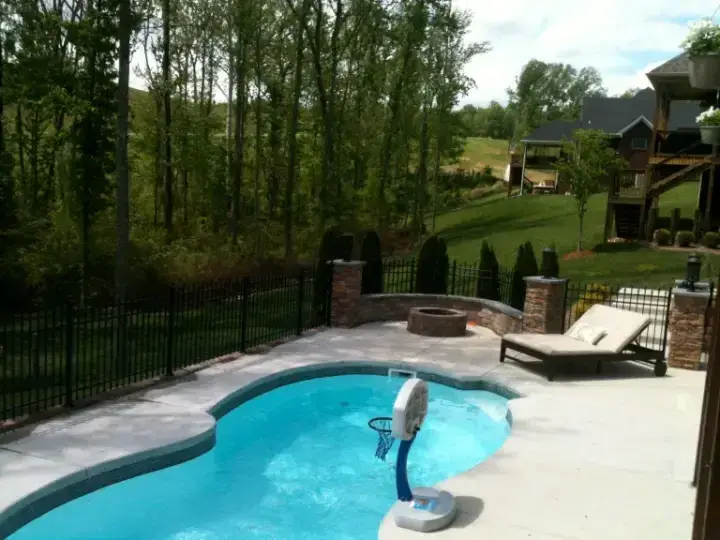
Pool barriers have their own rules, separate from regular fence heights. Louisville Metro’s swimming pool enclosure requirements say:
Minimum height
The pool barrier must be at least 48 inches above grade.
No gaps a child can pass
Openings can’t let a 4-inch sphere through, and the gap at the bottom can be no more than 4 inches.
Chain link mesh
Chain link barriers need mesh no larger than 2¼ inches square.
Gates open outward
Gates must open out, away from the pool, and be self-closing and self-latching.
Latch on the pool side
Low latch releases must be on the pool side of the gate. Ask Construction Review for the exact placement on your gate.
In-ground pools need a permit
Installing an in-ground pool requires a Metro building permit.
Source: Louisville Metro Construction Review, Swimming Pool Enclosure Requirements. Small cities and HOAs may add their own pool rules.
Corner lots
Corner lots and sight lines
Corner lots get extra rules, and they catch a lot of homeowners out.
Your “front” may surprise you
In Metro, the front of a corner lot is the shortest side that touches a public street, no matter which way the house faces or where the driveway is.
Street-side height limits
The street-side yard gets the same 4 ft limit (42 in. in traditional neighborhoods) as the front yard.
Keep the corner clear
Near an intersection, nothing in the vision clearance area can be more than 2 feet higher than the nearest curb. That includes fences, walls and shrubs.
Additional rules apply to corner lots. For your lot, call Metro Planning & Design at (502) 574-6230, or your city if you live in one of the small cities.
Neighbors
Which side faces out, and talking to neighbors
Metro’s rules don’t say which side of a fence has to face out. Some cities and many HOAs do. Prospect, for example, requires the finished side of a wood fence to face the neighbors. Even where it isn’t required, facing the finished side out is the usual courtesy.
Talk to your neighbors before the crew arrives, especially if the fence runs on or near the line. In Kentucky, neighbors can agree to build and maintain a fence between their properties, and a written agreement can be recorded with the county clerk.
When Miles installs your fence
We handle the rules with you
- We check before we build. Our team will always make sure your fence complies with local regulations.
- Permits, if you need one. We work with you to get any permits your fence needs.
- An on-site visit. Greg walks the fence line with you, looks at grade, gates and access, and helps you choose the material, style, height and gates.
- A written quote, sent shortly after the visit. No pressure, no obligation.
Want to know what it will cost? See How Much Does a Fence Cost in Louisville?
FAQ
Fence permit questions
Do I need a permit to build a fence in Louisville?
Most residential fences in Louisville, Kentucky do not need a permit. Louisville Metro requires a building permit only for fences over 7 feet tall. Some small cities in Jefferson County, such as Prospect and Hurstbourne, require their own permit, and some HOAs require architectural committee approval before work can begin.
How tall can a fence be in Louisville?
In Louisville Metro, side and back yard fences can be up to 6 feet if they are see-through (less than 80% opaque, like chain link) or up to 8 feet if they are solid. Front and street-side yard fences are limited to 4 feet in suburban neighborhoods and 42 inches in traditional neighborhoods. Fences over 7 feet need a building permit.
How tall can a front yard fence be?
In Louisville Metro, a fence in the front yard or street-side yard setback can be up to 4 feet tall in suburban form districts and 42 inches in traditional form districts. Within 5 feet of a public sidewalk or road, any change in ground height counts toward the fence height.
Do I need a fence permit in Jeffersontown?
No. The City of Jeffersontown says a permit is not currently required. Its limits are up to 4 feet in front and street-side yards, and in side and rear yards up to 8 feet for solid fences and 6 feet for chain link. On corner lots, fences can’t block drivers’ view of the intersection.
What are the pool fence requirements in Louisville?
Louisville Metro requires a pool barrier at least 48 inches above grade, with no opening that lets a 4-inch sphere pass and no more than 4 inches of clearance at the bottom. Chain link mesh can be no larger than 2¼ inches. Gates must open outward, away from the pool, and be self-closing and self-latching.
Do I have to call 811 before installing a fence?
Yes. Kentucky law requires a utility locate request at least two full working days, and no more than ten, before digging. It’s free: call 811 or use kentucky811.org.
Does the PVA map show my exact property line?
No. The Jefferson County PVA says its maps are not legal documents and should be used for general reference only. Use your plat or survey, and hire a surveyor if the fence will run right on the line.
Which side of the fence faces the neighbor?
Louisville Metro’s rules don’t specify it, but some cities and many HOAs do. Prospect, for example, requires the finished side of a wood fence to face the neighbors. Facing the finished side out is the usual courtesy either way.
Sources
Where these rules come from
- Louisville Metro Construction Review: Fence and Retaining Walls
- Louisville Metro Codes & Regulations: Fencing
- Louisville Metro Land Development Code (cities with their own zoning)
- Louisville Metro: Swimming Pool Enclosure Requirements
- City of Jeffersontown: fence FAQ
- KRS 367.4911: excavation notice (Kentucky 811)
- Jefferson County PVA: property maps
- KRS 256.020: division fences by agreement
Rules checked October 2026. This guide is general information, not legal advice. Always confirm with your city and HOA before you build.
Free, no-obligation quote
Request your free quote
Tell us about your project and we will get back to you within one business day.
"*" indicates required fields
- We reply within one business dayto set up a time to see your yard.
- Greg walks the fence line with youand helps you choose the material, style, height and gates.
- Your written quote followsshortly after the visit. No pressure, no obligation.